Skip to content
WorldNerve
All Sample Reports

Monitoring · Interactive Sample

Ongoing Monitoring and Change Detection

A baseline-and-update example that distinguishes persistent movement from a confirmed change in behaviour.

Built for sites, corridors, facilities, projects, and portfolios needing repeat review.

8 pages · PDF · 0.6 MBReal measurements · Baseline plus update
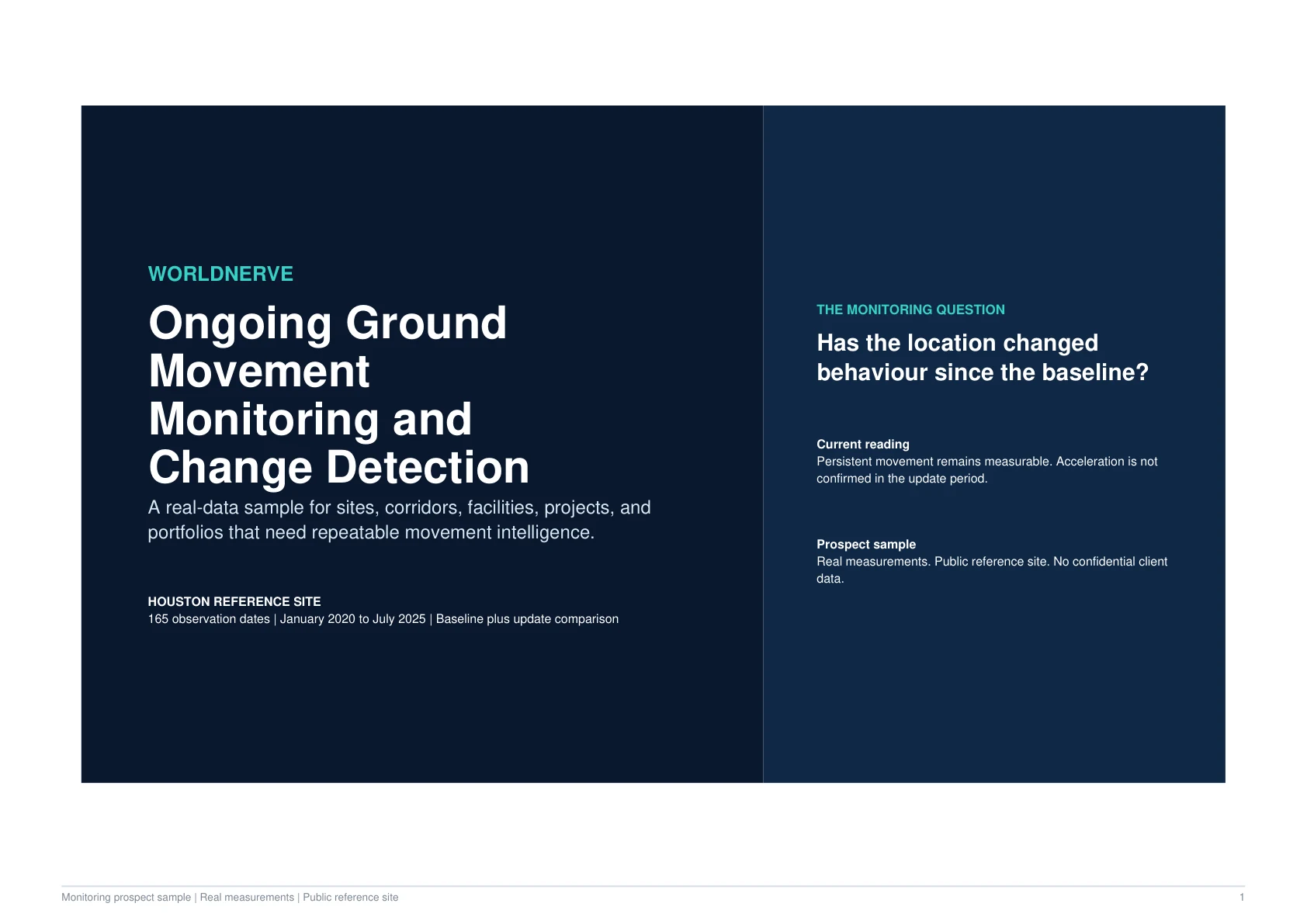
Cover of the WorldNerve Ongoing Ground Movement Monitoring sample
Full evidence pack available as a PDF download

Decision Question

Has the measured movement pattern changed materially since the baseline review?

Sample Finding

Movement remains present in the update period, but the sample does not confirm acceleration.

The status remains Review because persistence is still relevant even though the update-period rate is lower than the baseline rate.

Review
Current Status

Persistent movement

-3.0
Baseline mm/Year

Original review period

-0.8
Update mm/Year

Latest review period

5.5 years
Archive Length

165 observation dates

Interactive Evidence View

Baseline and Update Comparison

The comparison distinguishes continued movement from a confirmed increase in movement rate.

Baseline PeriodOriginal screening baseline
-3.0 mm/year
Update PeriodNo confirmed acceleration
-0.8 mm/year
Comparison unit: mm/year

This code-native view highlights selected report findings. Download the PDF for the complete maps, time series, methodology, confidence notes, and evidence tables.

Inside the Report

Follow the Evidence From Question to Action

The online experience explains the decision logic in a scannable format. The downloadable report preserves the full technical evidence record.

01

A Stable Baseline

The first review defines the location, evidence conditions, movement indicators, and status against which later observations are compared.

  • The monitoring question is fixed before the update.
  • Baseline confidence and coverage remain part of the record.
  • The status can be reproduced at the next review.
02

Change Detection

The update separates persistence, acceleration, deceleration, and evidence-quality changes instead of treating every new observation as an alert.

  • Baseline and update periods are reported separately.
  • Rate changes are interpreted with their measurement support.
  • The sample finds persistence without confirmed acceleration.
03

An Operational Monitoring Record

Each update preserves the previous conclusion, the new evidence, and the reason for any status change or continuation.

  • Review teams can see what changed since the last report.
  • Status history supports proportionate escalation.
  • Future updates can use the same evidence structure.

Responsible Interpretation

What This Evidence Does Not Decide

The report is designed to make its boundaries as visible as its findings.

  • A lower update-period rate does not by itself prove that movement has stopped.
  • Short-period changes may reflect measurement variability or evidence conditions.
  • The analysis does not determine structural condition or cause.
  • Alert thresholds should be agreed for the asset and decision context.

Next Steps

Turn the Finding Into a Proportionate Workflow

  1. 1

    Keep the site in review while the measured pattern persists.

  2. 2

    Compare the update with inspection, works, weather, and site records.

  3. 3

    Agree the next review interval and any escalation threshold.

Start a conversation

See What the Satellite Archive Can Support for Your Location

Start with an address, coordinate, boundary, corridor, or location list. WorldNerve will review feasibility before proposing a larger scope.